
FOR OWNER-LED PROFESSIONAL-SERVICES FIRMS
Most firms aim AI at the cost line. The real money is on the revenue line.
Your senior people spend a third of their week producing documents instead of doing the work only they can do. The instinct is to make them faster — bank the saving, trim the cost. But efficiency is the small lever. The big one is what those freed hours get redeployed into: more clients, deeper work, better advice — revenue the firm couldn't reach before. Done in the right order, the revenue grows while headcount doesn't, so the growth lands as almost pure margin. That redesign starts long before you pick a tool.
One lever banks the saving. The other compounds it.
When a deliverable that took six hours of senior time takes a fraction of that, you can do one of two things with the hours you got back. Bank them as cost saved — a one-off trim with a floor. Or redeploy them into work that grows revenue: more clients served, deeper analysis, faster turnaround clients pay a premium for. Run the PACT sequence first and the same team produces several times the output — and because no one was hired to do it, the new revenue arrives as almost pure margin. The sequence is what decides which lever you actually pull.
— THE TARGET
PROJECTED · ENGAGEMENT IN YEAR ONE
What the sequence is built to do over twelve months.
Same people. Same desks. Same clients. No new headcount — instead, the work is redesigned around the four pillars so the hours AI frees get redeployed into revenue-generating work, and AI is added last to run the new model. The top line grows while the labour line barely moves, so the growth arrives as almost pure margin. The figures below are the projected 12-month targets for a current professional-services engagement — the trajectory the sequence is designed to produce, not a finished result.
Read it in order: revenue grew, headcount didn't, so the growth fell to margin. If revenue had grown but margin hadn't, the firm would just be bigger, busier and equally thin — margin is the check that the growth was real, not the goal in itself. Stated plainly as what it is: a projected 12-month target for an engagement still in its first year, for a firm with the same cost structure, growth ceiling and senior-time bottleneck as most in this band. We'd rather under-claim and let the framework do the convincing. The proof matures as the year completes.
— WHY THIS IS GROWTH, NOT JUST DEFENCE
There are two things to do with the hours AI frees. Only one of them actually grows the firm.
The defensive move is real and worth making: bank the saving as margin so that when competitors weaponise AI on price — and in professional services that race has already started — you have the buffer to absorb the hit instead of discounting yourself into irrelevance. A firm sitting at 15–20% has no room when fees compress. Strong margin is the buffer that lets you survive a price war you didn't start.
But banking the saving is the small lever, and it has a ceiling — once you hit 40% there's nowhere left to go. The big lever is redeployment: pointing those freed hours at revenue the firm couldn't reach before. That lever has no ceiling, and it's where the real upside lives. The trap isn't that AI shrinks the invoice. It's that most firms stop at the saving and never pull the lever that grows.
AI's job in your firm is not to make you cheaper. It's to free your senior people's hours and point them at growth — more clients, deeper work, premium advice — while the margin you build buys the time to do it. You don't win the price war by joining it — you win by being the firm that turned the same technology into a bigger, more profitable business while everyone else used it to discount.
Defence: 40%+ margin is the buffer. It lets a firm weather fee compression, reward its best people, and command a real multiple on exit. Below it, every shock lands on the owner.
Offence: growth is the lever without a ceiling. Redeploy the freed hours into more clients and deeper work and the top line moves — and because headcount didn't, it lands as margin too.
Together they compound. The same AI hour that makes a rival cheaper makes a PACT firm both more profitable and bigger — if you change the model first and aim the hours on purpose.
— AN HONEST CAVEAT
Most firms don't sell hours — but they price and measure by them.
Plenty of professional-services firms quote fixed fees or value-based pricing. But scratch the surface and the hour is still the unit underneath: it's how you cost a job, how you scope a quote, how you measure whether a person is "busy enough." So when AI compresses the hours, the instinct is still to compress the fee — and the same leak opens, just one layer down.
The hour is the hidden unit
Even on a fixed-fee engagement, you scoped it on estimated hours and you'll judge its profitability on hours spent. AI quietly removes those hours — so unless you change how you justify the fee, the next quote drifts lower to match the lower effort.
Keep adding value to hold the price
A 40%+ margin has to be earned in the eyes of the client. The firms that hold premium fees while their costs fall are the ones visibly adding more — faster turnaround, deeper analysis, better advice, fewer errors — not the ones quietly doing the same work in less time and hoping nobody notices.
Freed hours become new revenue
Run the sequence and the saved hours don't vanish into a discount — and they don't just sit as a cost saving either. They're redeployed into the work that grows the firm: more clients taken on without hiring, deeper analysis that justifies a higher fee, the advisory work only your seniors can do. The fee stays justified, the top line moves, and because no one was hired to deliver it, the growth lands in your margin instead of the client's.
The reason most firms can't pull this off: they start with the tool.
— THE WAY OUT
A pact is a binding agreement between two parties. AI adoption is no different. The business and the people doing the work have to agree on who, why, and what — long before they argue about which tool. Skip the agreement and you don't get adoption. You get resentment with a subscription. PACT runs the sequence in reverse, and that single flip is why it sticks.
People
"Who is this for, and who decides it lives or dies?"
Approach
"Where does the work actually break?"
Case
"What number, by when, is the win?"
Tech
"Which tool — finally?"
Adopt the people. Audit the work. Agree the win. Only then, choose the tool. Re-score every ninety days. Repeat until the method is invisible — because by then it's just how you operate.
How much growth capacity is trapped in report production?
DO THE MATHS YOURSELF
No form. No email. Move the sliders to your firm and watch the number appear — the senior hours a redesigned process hands back, and what they're worth once redeployed into revenue work instead of banked as a one-off saving. It's run conservatively on purpose. A mirror with arithmetic, not a pitch.
That's roughly 1,382 senior hours a year a redesigned process hands back — before a single tool is chosen. Banked as a saving, it's a one-off trim. Redeployed into client work, it's new revenue.
CONSERVATIVE MODEL · TIME SAVED × LOADED COST × A 0.7 REAL-WORLD ADOPTION DISCOUNT. YOUR NUMBER IS IN YOUR OWN HANDWRITING.
Tech fails publicly. People fail quietly.
— WHY IT USUALLY FAILS
Every public AI failure looks like a model problem — because the model is the only failure you can see from outside the building. Read the right-hand column: the pillar that was actually skipped is almost never the one the post-mortem blames.
Thirty thousand seats roll out. Six months later, fewer than one in five log in. The licence renews anyway. Somewhere in the original memo, the "case" was simply transformation.
A back office automates document review and watches throughput double — until the downstream approval queue collapses. They automated a pipeline whose real constraint sat one step further on.
A finance team licenses a state-of-the-art platform off a vendor demo. Eighteen months on it runs two reports an analyst could've written in SQL. The tool wasn't wrong. The sequence was.
Augment, don't amputate.
THE GROWTH THESIS
Around 80% of organisations have cut headcount to fund AI — and the research says the cuts don't deliver the return. The budget room becomes the outcome; the capability never gets built. You end up smaller, not more capable.
PACT points the other way. The senior whose hours AI frees isn't made redundant — they're redeployed onto the high-value, revenue-generating work only they can do. The model is designed to add zero headcount and lose nobody: the firm grows because freed capacity is aimed at new revenue, and that growth lands as margin because no one was hired to deliver it.
"What is the measurable workflow output we will audit two quarters from now — and who, specifically, by name, still works here to run that audit?"
Automate the mundane. Let agents own the repetitive, low-judgment work that burns senior hours.
Elevate the people. Free your team for the advisory and relationship work that actually earns the premium.
Protect the value, tool-agnostic. People, Approach and Case stay fixed while the tech swaps in and out — so you never rebuild the firm every time the models change.
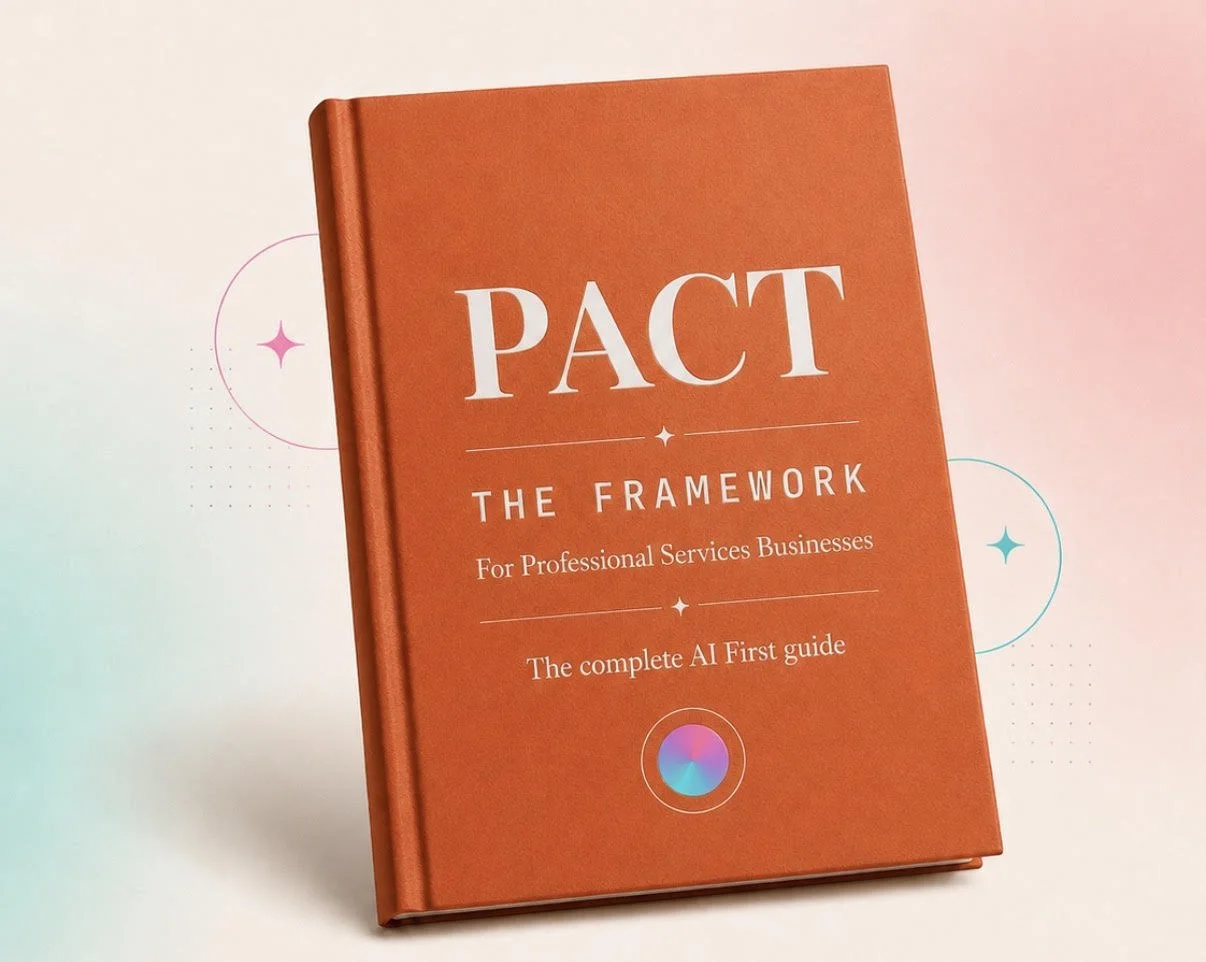
READ IT FREE, RIGHT HERE
The whole framework.
No gate. Truly free.
For Professional-Services Firms. The complete field guide — the four pillars, the growth maths, and the use cases that move a firm like yours. Read it on the page, or take the PDF with you. We only ask for an email if you'd like us to send it — and that's a thank-you, not a toll.
The PACT framework in full. All four pillars, the sequence, and the diagnostic — laid out so your whole leadership team can follow it on a Thursday afternoon.
Where the growth actually hides. The handful of use cases — starting with document production — that move a professional-services top line the most, ranked by impact, with margin as the proof they worked.
The order to build in. What to ship in the first 90 days, what comes next, and why sequence beats speed every time.
How freed hours become revenue, not a discount. The redeployment move that turns efficiency into top-line growth — and the redesign that does it before you touch a single tool.
WHERE SHOULD I SEND IT?
Just the guide and the occasional honest note on the framework. Nothing you didn't ask for. Unsubscribe anytime.
Start with a number, not a commitment.
WHEN YOU'RE READY — NO PITCH
Most firms sell you a six-figure transformation. We'd rather hand you a diagnosis first. Every step here is still a give — you only go deeper if the last step earned it.
The PACT Score
A scored audit across all four pillars. One page, one number, one broken pillar named. Most owners don't know which pillar is actually broken until they see it — and most guess wrong.
FreeThe Diagnostic Walkthrough
We map your top three growth leaks live, in dollars — where freed capacity is going to waste, run like a consultant — not a salesperson. You leave with the picture whether or not we ever work together.
No-obligationThe PACT Build
End-to-end execution through the four pillars, co-built with your team so the system has a home when we leave. We don't touch a tool until People, Approach and Case are signed off in writing.
I watched thirty transformation projects fail the same way. So I wrote down the pattern that worked.
— NICK HUGHES · SEVEN YEARS, THIRTY-PLUS TRANSFORMATIONS · THE STORY →
THE LITMUS QUESTION
Could a CFO who has never heard of you read one page and write the cheque?
If yes — who, how, what, which, in that order, each tied to a name and a number — you have a PACT. If no, you have a project that will look fine in a pitch deck and disappear by Q3.