
— THE METHOD IN FULL
FOUR PILLARS · ONE SEQUENCE
Four pillars.
One sequence.
The agreement every business makes with AI — in this order, or not at all. Each pillar earns its place by surviving a single question. Skip the question, skip the pillar, and the whole stack tilts.
PILLAR 01 OF 04 · FOUNDATION
THE HEARTBEAT · WHO
People
Before a single tool is named, you map the people. Who's affected. Who decides. Who operates. Who'll quietly resist. The most elegant AI system in the world dies on the hill of a team who didn't ask for it. Most failures here are failures of imagination — leaders forgetting that the people doing the work are also the people who decide whether it survives Q2.
Adoption is a human problem dressed up as a technical one.
The Question · 03
"What number, on what date, would let us call this a win — or a failure we can recover from?"
Failure Mode If Skipped
A tool in search of a problem.
The Failure Test
Finish the sentence: "If, in 90 days, __ has not happened, this project has failed." If you can't fill the blank with a number and a date, you don't have a case yet. Then ask the growth version: "the hours we freed got redeployed into __" — if that blank is empty, the saving will quietly leak away as a discount.
Stands On
People + Approach. Without them, the case is theatre.
A case is only credible once the people are mapped and the process is understood. Otherwise the "outcome" is a slide-deck number — impressive in the pitch, untraceable in the result.
PILLAR 02 OF 04 · PROCESS
THE BLUEPRINT · HOW
Approach
With the people mapped, you turn to the work itself. What's the process today? Where does it break? Where does it duplicate? Which steps would you eliminate, which automate, which keep human? Approach is process literacy — the discipline of seeing how work actually moves through your business before you let AI touch it. It's the slowest pillar to get right and the one most companies skip.
Automating a broken process makes the broken process faster.
The Question · 02
"Where does the work actually break — and what step would you delete if nobody was watching?"
Failure mode if skipped
Automating a broken workflow faster.
Eliminate / Automate / Keep Human
Walk every step and label it E, A, or H. The Es are the surprise — they save more time than the As, and they don't need any AI at all.
Stands on
People. Without them, your process map is a fantasy.
A process map drawn without the people who actually do the work is a wishlist. Approach only works once People has been honestly answered — because the people are the ones who know where the bodies are buried.
PILLAR 03 OF 04 · OUTCOME
THE WAGER · WHAT
Case
The Case is the specific outcome you're buying with this work — and not all outcomes are equal. The highest-value cases are growth cases: more clients served without hiring, faster turnaround clients pay a premium for, a capability you didn't have, deeper work that lifts the fee. Cost-only cases — "we'll spend less" — are the floor, not the ceiling; on their own they stall at efficiency and never compound. The strongest Case names where the freed capacity gets redeployed, because capacity that isn't aimed at something grows nothing. If the case can't be stated in one sentence and tied to a number, it isn't a case — it's a wish. Most AI projects die here, not because the technology fails, but because nobody agreed up front on what success would even look like.
If you can't name the outcome, you can't claim a win.
"What number, on what date, would let us call this a win — or a failure we can recover from?"
A tool in search of a problem.
Finish the sentence: "If, in 90 days, ___ has not happened, this project has failed." If you can't fill the blank with a number and a date, you don't have a case yet. Then ask the growth version: "the hours we freed got redeployed into ___" — if that blank is empty, the saving will quietly leak away as a discount.
People + Approach. Without them, the case is theatre.
A case is only credible once the people are mapped and the process is understood. Otherwise the "outcome" is a slide-deck number — impressive in the pitch, untraceable in the result.
PILLAR 04 OF 04 · THE BUILD
THE INSTRUMENT · WHICH
Now — and only now — the tool. Which platform, which model, which integration, which automation. By the time you arrive here, the choice has already been narrowed for you: the people you mapped, the approach you redesigned, and the case you committed to leave only a handful of viable options. Tech becomes the easiest pillar, not the hardest, because the previous three did the work.
Tech
The tool is the last decision, not the first.
The Question · 04
"Which tool, configured how, integrated where — and why this one?"
Failure mode if skipped
A shiny object with no return.
The Loop Back
PACT is sequenced, not one-shot. The first contact with Tech almost always reveals a gap in Approach, sometimes one in People. That isn't failure — that's the method working. Re-score every quarter.
Stands On
All three below. Skip any and Tech runs into the dark.
Tech is the cap on the pillar stack. By the time you're choosing tools, the previous three pillars have already eliminated 80% of the wrong answers. That's the gift of the sequence.
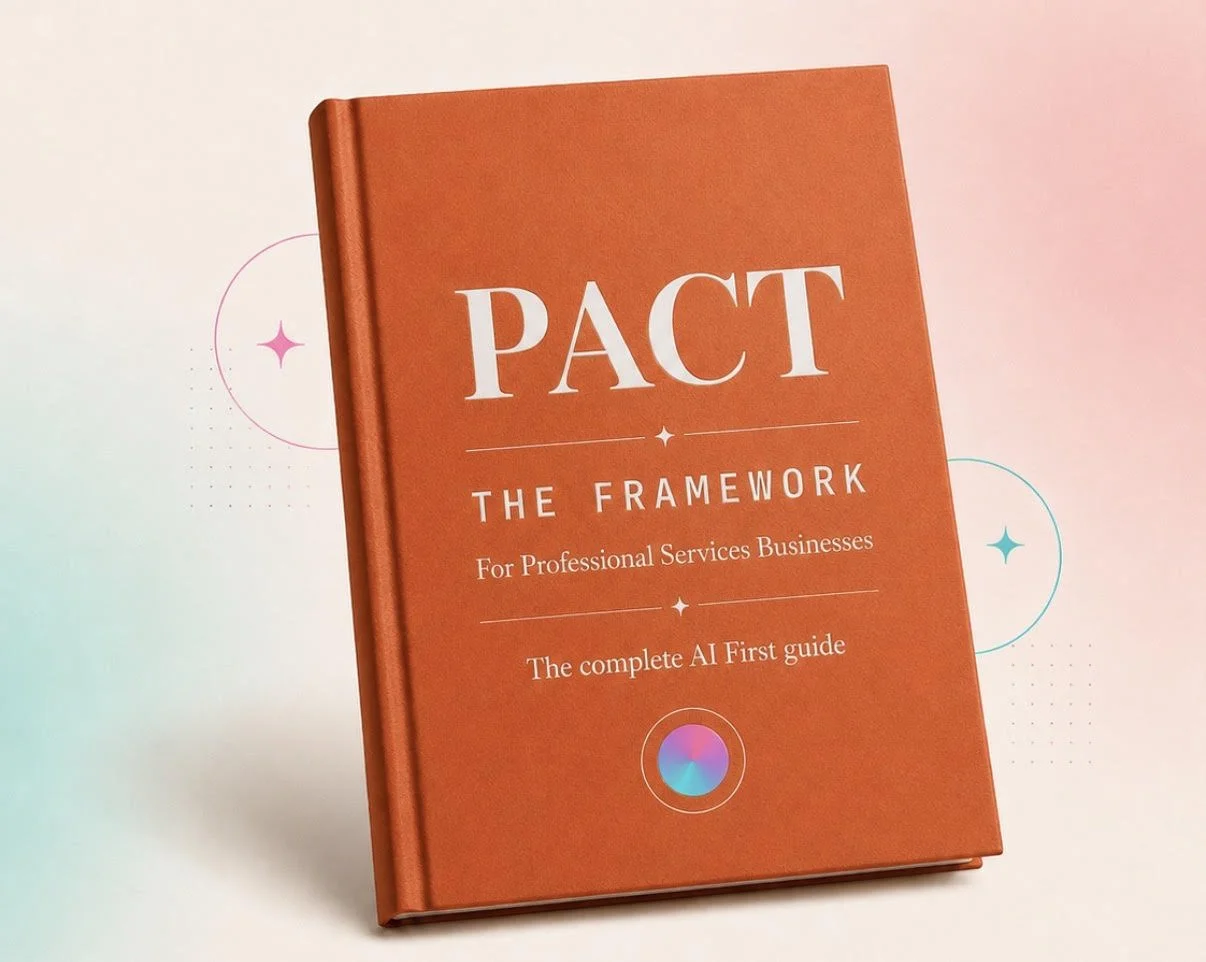
The whole framework.
No gate. Truly free.
— READ IT FREE, RIGHT HERE
For Professional-Services Firms. The complete field guide — the four pillars, the growth maths, and the use cases that move a firm like yours. Read it on the page, or take the PDF with you. We only ask for an email if you'd like us to send it — and that's a thank-you, not a toll.
The PACT framework in full. All four pillars, the sequence, and the diagnostic — laid out so your whole leadership team can follow it on a Thursday afternoon.
Where the growth actually hides. The handful of use cases — starting with document production — that move a professional-services top line the most, ranked by impact, with margin as the proof they worked.
The order to build in. What to ship in the first 90 days, what comes next, and why sequence beats speed every time.
How freed hours become revenue, not a discount. The redeployment move that turns efficiency into top-line growth — and the redesign that does it before you touch a single tool.
WHERE SHOULD I SEND IT?
Just the guide and the occasional honest note on the framework. Nothing you didn't ask for. Unsubscribe anytime.
ON TECH, SPECIFICALLY
Stay tool-agnostic.
The best platforms will change rapidly. Models improve, APIs get cheaper, new agents arrive every month. PACT keeps People, Approach and Case fixed so you can swap the tech in and out as the frontier moves — without rebuilding the business each time.
A framework that's bolted to one vendor is just lock-in with better branding. And no single tool does it all — Tech is a stack of thinking tools and plumbing tools, chosen deliberately and wired together. See why the stack matters →
Find the broken pillar in ten minutes.
— THE DIAGNOSTIC · 12 QUESTIONS
Three questions per pillar. Score each honestly: 0 if no, 1 if partly, 2 if yes. Add the totals. The lowest pillar is where the work starts — and where most of the value comes from before a single tool is touched.
P · 01 PEOPLE
- Can you name the three roles most affected, and the one person who decides this lives or dies?
- Has someone outside the executive team voiced a real reservation — and been heard, not handled?
- Do the operators have time and incentive to learn, or are you assuming both?
A · 02 APPROACH
- Has the current process been mapped end-to-end by someone who actually does the work?
- Has at least one step been marked for elimination — not automation, elimination?
- Can you point to the one bottleneck that, if cleared, matters more than the rest combined?
C · 03 CASE
- Is the outcome stated in one sentence, with one number and one date?
- Could you finish "If X hasn't happened by then, this has failed" — and would the team agree?
- Is there a named owner whose review depends on it, not just a sponsor whose memo mentions it?
T · 04 TECH
- Was the tool chosen because the prior three pillars narrowed it — or because someone read about it?
- Has it been integrated where the work actually happens, or bolted on next to it?
- Is there a re-score date in the calendar, or are you treating "deployed" as "done"?
SCORING · /24 TOTAL · /6 PER PILLAR
5–6 per pillar: honoured. 3–4: shaky, reinforce before moving on. 0–2: the work starts here. The score earns its place by being uncomfortable.
Could a CFO who has never heard of you read one page and write the cheque?
— THE LITMUS QUESTION
If yes — who, how, what, which, in that order, each tied to a name and a number — you have a PACT. If no, you have a project that will look fine in a pitch deck and disappear by Q3. PACT is the difference.
Adopt the people. Audit the work. Agree the win. Only then, choose the tool. Re-score every ninety days. Repeat until the method is invisible — because by then it's just how you operate.
FREE DIAGNOSTIC · 2 MINUTES · GETYOURSCORE.AI
WHERE PACT FITS
The conductor, not the orchestra.
PACT doesn't replace the great frameworks shaping AI thinking — it sits above them as the business sequence that decides when and how to use them. The 3 Ms teach a way of thinking. The 4 Cs are the technical anatomy. PACT is the agreement the organisation makes before either becomes useful.